CBSE On-Screen Marking (OSM) Explained: How Class 6, 7 & 8 Students Should Prepare Right Now
CBSE made OSM mandatory for Class 12 board exams starting 2026. Here's what it means, how it works, and exactly why Class 6, 7 & 8 students should start building OSM-ready habits right now.
What Is CBSE On-Screen Marking (OSM)?
Imagine your Class 12 answer sheet being scanned like a document and sent to a teacher — who then checks it on a computer screen instead of a physical paper. That's exactly what CBSE's new On-Screen Marking (OSM) system does.
CBSE officially announced OSM on 9 February 2026, making it mandatory for all Class 12 board exams starting 2026. Class 10 continues with physical checking for now — but is also expected to shift to OSM in coming years.
Simple Definition: OSM = Your handwritten answer sheet is scanned → uploaded to a secure digital platform → checked by a teacher on a computer screen. You still write on paper. Only the checking process has gone digital.
CBSE conducts exams for nearly 46 lakh students across India and 26 other countries every year. Managing physical answer sheets at this scale was a huge logistical challenge — OSM solves it digitally.
How OSM Works — Step by Step
The process is simple, secure, and transparent. Here's exactly what happens after you submit your answer sheet:
- Scanning: Physical answer sheets are collected and scanned using high-resolution scanners at designated CBSE centres. Every single page is captured in detail — including diagrams and rough work.
- Masking (Identity Hidden): Your name and roll number are digitally hidden before the examiner sees the sheet. This ensures completely anonymous and unbiased evaluation.
- Digital Evaluation: Teachers log into a secure CBSE portal and check your scanned answer sheet on their computer screens — question by question — using the official marking scheme.
- Auto-Totalling of Marks: The system automatically adds up all marks. This eliminates the human totalling errors that used to cost students marks in traditional evaluation.
- Centralized Monitoring: CBSE can track evaluation progress in real time, ensuring every examiner follows the same standard — making results more uniform and fair.
Important: CBSE revealed that during the 2026 evaluation of 98 lakh scanned sheets, over 13,000 answer sheets could not be read properly because students used very light-coloured ink. Those had to be manually checked separately — causing delays and stress. Always use dark blue or black ballpoint pen!
Which Countries & Boards Use OSM?
India is not the first to adopt this system. OSM is a globally trusted practice used by some of the world's most respected exam boards:
| Board / Exam | Country / Reach | Status |
|---|---|---|
| Cambridge (CAIE) | UK & 160+ countries | Long established |
| IB (International Baccalaureate) | 150+ countries worldwide | Long established |
| Pearson Edexcel | UK & International schools | Since 2021 |
| CBSE | India & 26 countries | 2014, relaunched 2026 |
"It has become a norm internationally because through technology, it enables us to conduct the entire system in a more transparent manner."
— Sanjay Kumar, School Education Secretary, Ministry of Education, India
The Ministry of Education clarified that OSM is not new for CBSE — it was first introduced back in 2014, and has now been relaunched with full-scale implementation for Class 12 in 2026.
What Students Must Take Care of While Writing Exams
With OSM, your answer sheet is read on a screen — not in hand. This changes how much your presentation matters. Here are the 12 key things every student must follow:
- Use the Right Pen: Always use a dark blue or black ballpoint pen. Avoid gel pens that smear. Light ink does not scan clearly and can cost you marks.
- Write Neatly & Legibly: Your answer is viewed on a screen — sloppy handwriting is harder to read digitally. Clear, neat writing = more marks.
- Stay Within Margins: Don't write outside the margins — scanners may crop content outside the area, making it invisible to the examiner.
- Number Questions Clearly: Write question numbers bold and clearly visible. Examiners mark question-by-question and must instantly identify each answer.
- Leave Line Spacing: Don't cram text together. Leave breathing space between answers and lines so the scanned image reads easily.
- Avoid Overwriting: Cutting and overwriting looks messy on screen. Strike through once if you make a mistake — never scribble heavily.
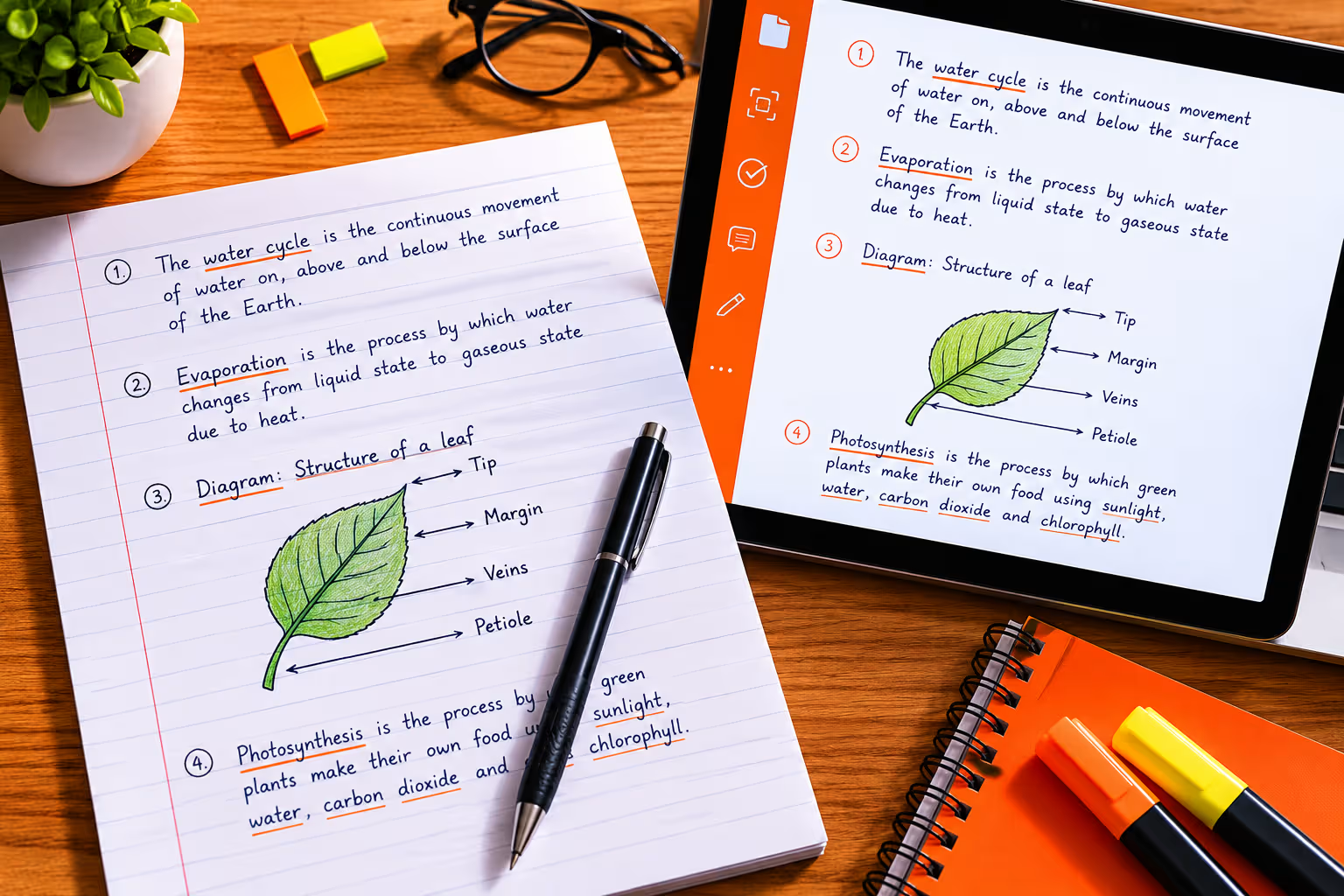
- Use Headings & Bullets: Structure answers with clear headings, numbered points, and sub-headings. Well-organised answers are easier to award marks to.
- Dark Diagrams & Labels: Draw diagrams with dark, clear lines. Label everything properly. Light pencil diagrams may not scan clearly.
- Write in Correct Section: Write answers only in the matching section of the answer book. Answers in wrong sections will NOT be evaluated.
- Answer Exactly What's Asked: Under OSM, extra content does not earn effort marks. Be precise and on-point. Quality matters more than quantity.
- Manage Your Time: Allocate time per question based on marks. Don't overspend on any one question — attempt all questions for step marks.
- Use Keywords & Underline: Underline key terms and formulas. Examiners award marks based on keywords — make them visible and unmissable on screen.
The Golden Rule of OSM: It's no longer just WHAT you write — it's also HOW you write it. A well-presented answer with dark ink, clear structure, and proper margins will always score better on screen than a messy but correct one.
Why Should Class 6, 7 & 8 Students Care About OSM?
You might be thinking — "OSM is for Class 12 right now. Why should I worry in Class 6?" Great question! Here's exactly why it matters for you:
| Reason | What This Means for You |
|---|---|
| OSM will reach Class 10 soon | CBSE has mentioned plans to extend OSM to Class 10 — your board exam. The habits you build now will directly matter when it arrives. |
| Good habits take years to build | Handwriting, answer structure, and presentation cannot be fixed in the last month before boards. They need daily practice — starting now. |
| Your school exams benefit too | Whether or not OSM applies to your exam, neat and well-structured answers always score higher. Your school teacher rewards good presentation as well. |
| You have a massive head start | Most Class 6–8 students don't know about OSM yet. By knowing this and preparing early, you are already ahead of thousands of future board exam students. |
| Your writing style is still forming | It's far easier to build the right habits at Class 6 than to break bad habits at Class 11. Now is the best time to start. |
Grade-wise Preparation Plan
Here's exactly what students in each class can do right now to stay ahead:
Class 6 — Build the Foundation
- Switch to dark blue or black ballpoint pen
- Practice writing within margins every day
- Write question numbers big and bold
- Start leaving a line gap between answers
- Focus on neat, legible handwriting
Class 7 — Structure Your Answers
- Use headings and bullet points in long answers
- Practice writing to-the-point answers
- Label all diagrams with dark pencil or pen
- Underline keywords and important terms
- Do 1 timed practice test per month
Class 8 — Polish & Perform
- Practice full answer sheets under time pressure
- Eliminate overwriting — use single neat strike-through
- Master intro-body-conclusion for long answers
- Practice writing neatly even when writing fast
- Learn to self-check presentation before submitting
OSM is a global best practice. CBSE has joined Cambridge, IB, and Pearson by adopting it. As a Class 6–8 student, you have the best possible head start. Build the habits of dark ink, neat writing, structured answers, and clear diagrams — and by the time OSM applies to your board exam, it will feel completely natural.
Frequently Asked Questions
Does OSM apply to Class 10 exams right now?
No. As of 2026, OSM applies only to Class 12 board exams. Class 10 answer sheets are still checked physically. However, CBSE has indicated plans to extend OSM to Class 10 in the future.
Can I still use pencil in my exams?
Pencil is allowed for diagrams, maps, and graphs. But for written answers, always use a dark blue or black ballpoint pen. Light-coloured pencil or gel pen may not scan clearly under OSM.
Will my diagrams and rough work be visible to the examiner?
Yes! Every page is scanned, including rough work and diagrams. However, they must be drawn with dark enough lines to show up clearly in the scan. Light pencil diagrams may not be clearly visible.
What if I make a mistake while writing?
Do not scribble or overwrite. Simply draw a single neat line through the incorrect text and write the correct answer below or beside it. Heavy scribbling looks very messy when scanned and viewed on screen.
Does neat handwriting really affect marks under OSM?
Absolutely. When your answer is viewed on a screen (not physically held), illegible handwriting is even harder to read. Clear, neat handwriting ensures the examiner can read and reward every point you make.
Is OSM fair for all students?
Yes — and in many ways fairer. The system hides student identity (anonymous evaluation), auto-checks totals, and records every examiner action. It is the same system trusted by Cambridge and IB for years.
Share this article
Share it wherever your readers already are.
About Shradha Singh
Shradha Singh is an experienced educator and the founder of Study With Shradha. With a passion for making quality education accessible to all, Shradha creates engaging video lessons and educational content that help students excel in their CBSE curriculum. Her clear teaching style and dedication have helped thousands of students across India achieve their academic goals.